Compassionate Action. Sustainable Impact. Global Transformation.
We are a professional, faith-driven global development organization partnering with the world's most vulnerable communities to break the cycle of poverty through evidence-based, long-term solutions.


Expanding the Neighborhood: Our Philosophy
Through our proud affiliation with Good Neighbor Day America, Mercy of God Mission International is redefining what it means to be a neighbor in the twenty-first century. The biblical and humanitarian definition of a neighbor transcends oceans, borders, and cultures—it is anyone whose suffering we have the power to alleviate. We invite American citizens, corporations, and grant-making foundations to look beyond their immediate backyards and recognize their fundamental connection to the global human family. Partnering with us offers an unparalleled opportunity to invest in sustainable, community-driven solutions that attack the root causes of poverty rather than merely treating its symptoms.
Our Core Pillars of Intervention in Ministry
- Healing the Body and Soul (Healthcare & Spiritual Outreach)
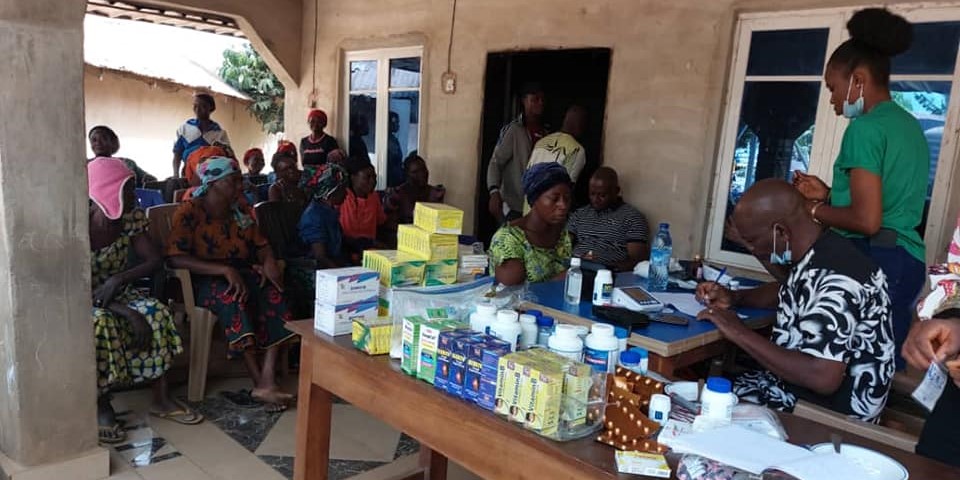
In remote communities where basic healthcare is nonexistent, preventable ailments become fatal tragedies. We deploy mobile medical clinics and establish rural health outposts staffed by dedicated professionals who provide life-saving medications, pediatric immunizations, and critical prenatal care. Because we believe physical healing must be accompanied by spiritual hope, our missionaries simultaneously plant vibrant, community-centric churches and offer trauma-informed spiritual counseling.
- The Wellspring of Life (Water, Sanitation, and Hygiene - WASH)
The water crisis is a devastating engine of poverty that forces women and young girls to walk miles daily, exposing them to waterborne diseases and robbing them of an education. We utilize advanced technology to drill deep-water, solar-powered boreholes that provide a reliable, zero-emission source of pure water. We pair this with comprehensive community hygiene training and eco-friendly sanitation facilities to permanently eradicate waterborne illnesses.
- Illuminating the Future (Education & Orphan Care)
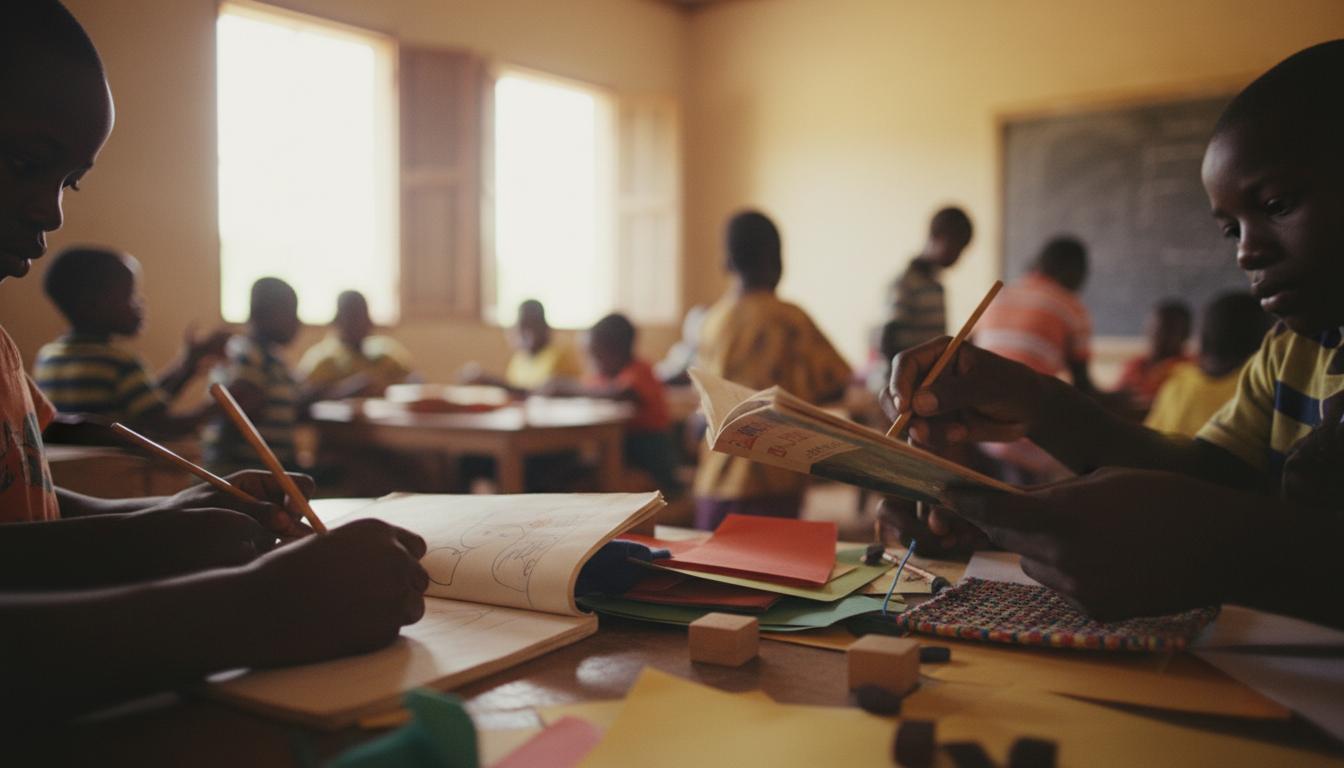
Education is the ultimate equalizer. We construct weather-proof, modern classrooms, equip them with essential learning materials, and provide solar reading lamps so students can study safely after dark. Through comprehensive child sponsorship and our community-based Orphan and Vulnerable Children (OVC) foster care programs, we ensure that every child receives trauma counseling, medical care, and unconditional love.
- Restoring Dignity (Women’s Empowerment & Agriculture)
When you empower a woman, the impact ripples outward to uplift her entire community. We organize marginalized widows and single mothers into supportive community savings groups, providing vital seed capital and vocational training to launch small, sustainable enterprises. Simultaneously, our Sustainable Agriculture pillar transitions vulnerable communities toward climate-smart agribusiness, providing drought-resistant seeds and drip-irrigation technology to ensure lasting food security.
Who We Are
Faith in Action, Grounded in Professional Excellence
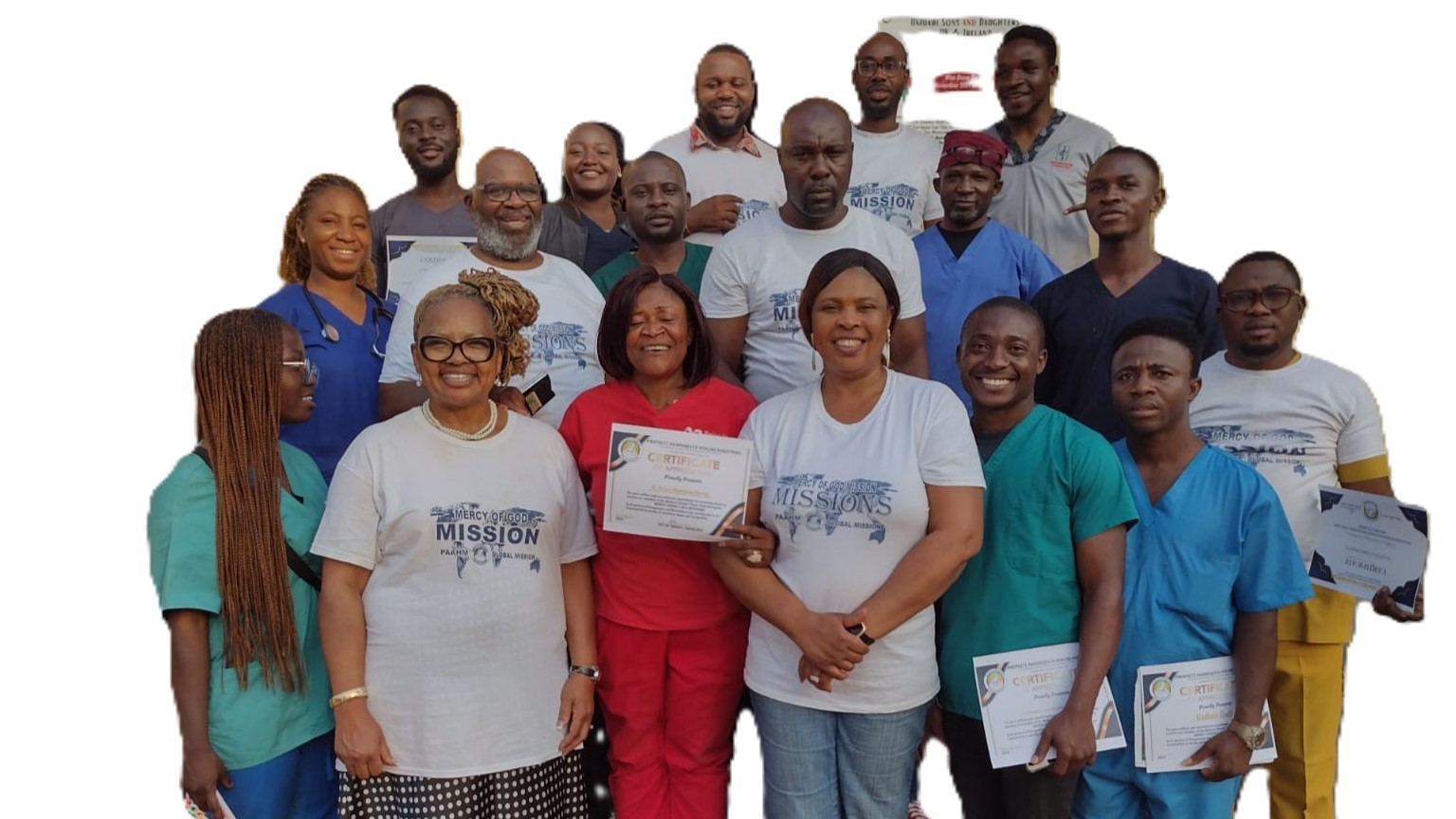
 professional development work. We recognize that good intentions alone are insufficient to solve the complex, multi-generational problems of poverty; they must be backed by robust strategy, operational excellence, and measurable accountability. Guided by our comprehensive 2025-2030 Strategic Blueprint, we focus our efforts on addressing the deep-seated root causes of poverty—such as lack of education, poor health systems, and economic exclusion—rather than merely treating the symptoms.
Our Program Pillars
Our Integrated Theory of Change
We do not work in silos. Poverty is multidimensional, and therefore our solutions must be integrated. We utilize a holistic Theory of Change where four core pillars work together synergistically to build resilient families and thriving communities.
Health & Nutrition:
We go beyond treating illness to strengthening entire local health systems. By training community health workers, upgrading rural clinics, and focusing intensely on maternal and child nutrition, we aim to drastically reduce preventable mortality rates and ensure that every child has the physical foundation to learn and grow.
Education & Skills Development:
We view education as the ultimate catalyst for transformation. Our work involves not only building safe schools but also training teachers in modern pedagogy and providing market-relevant vocational skills to out-of-school youth, ensuring they have the tools to enter the workforce with dignity.
Trust & Accountability
 Radical Stewardship and Transparency
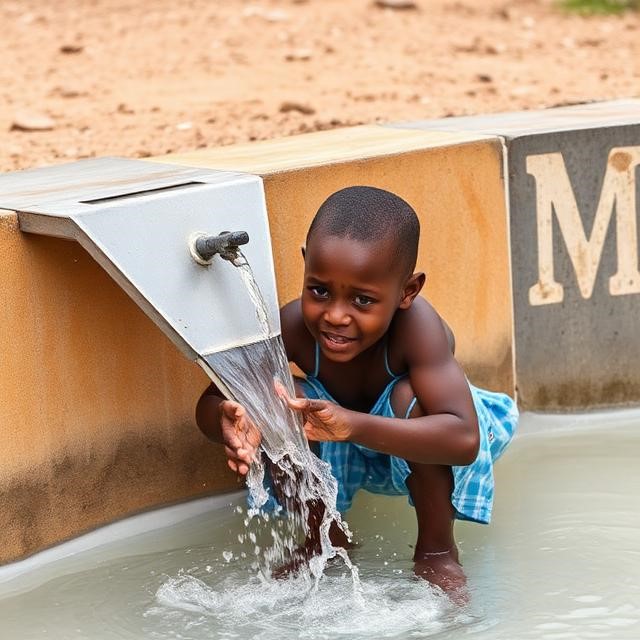
Trust is the currency of our work, and we strive to earn it every day through rigorous accountability. We view every donation as a sacred trust from God and our supporters, and we manage these resources with the highest level of financial discipline.
- Financial Efficiency: We are committed to keeping administrative overheads low, ensuring that 87% of our total expenditures go directly to program services that benefit the community.
- Evidence-Based Results: We utilize a professional Monitoring, Evaluation, Accountability, and Learning (MEAL) framework. We don't just count outputs; we measure outcomes and impact to prove that lives are actually changing.
- Zero-Tolerance Policy: We maintain and strictly enforce a board-approved Anti-Fraud and Anti-Corruption Policy, as well as a Safeguarding Policy to protect the vulnerable. We have confidential whistleblowing channels and investigate all irregularities to ensure total integrity.
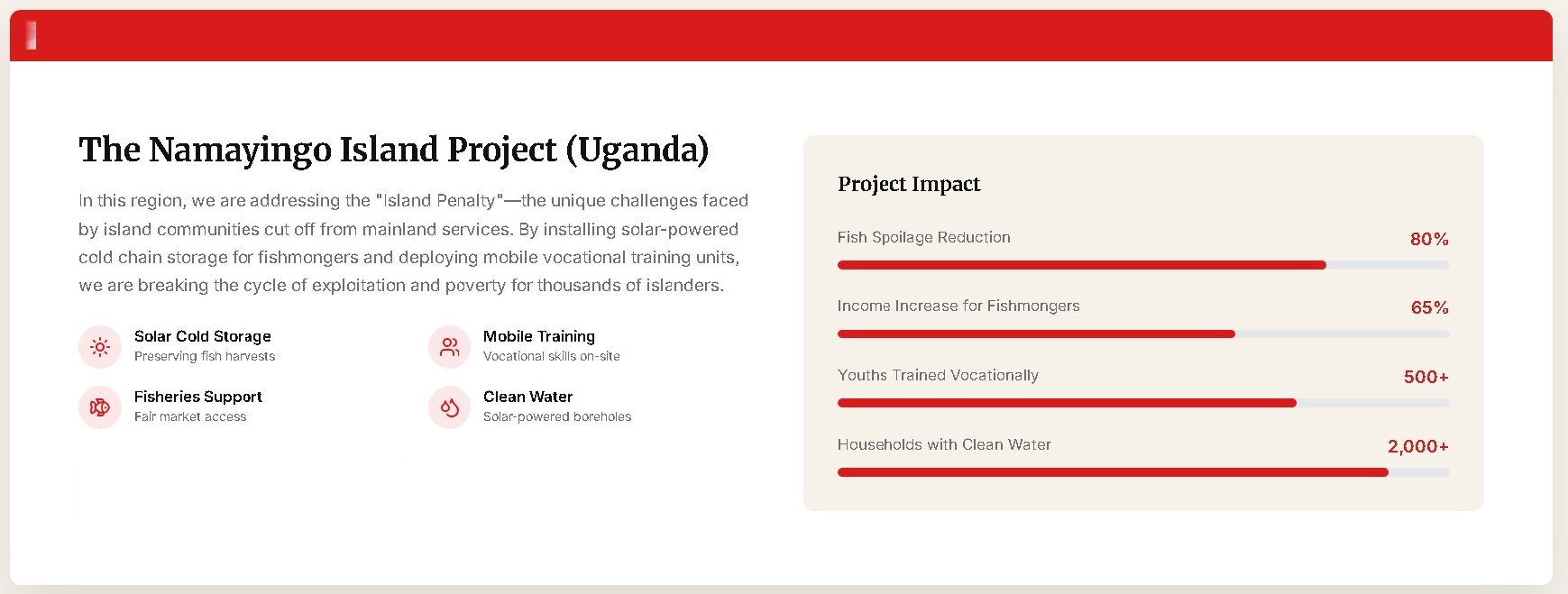
Project Title: The Namayingo Hub — Integrated Solar Infrastructure for Livelihoods, Water, and Skills
Location: Namayingo District, Lake Victoria Shore, Uganda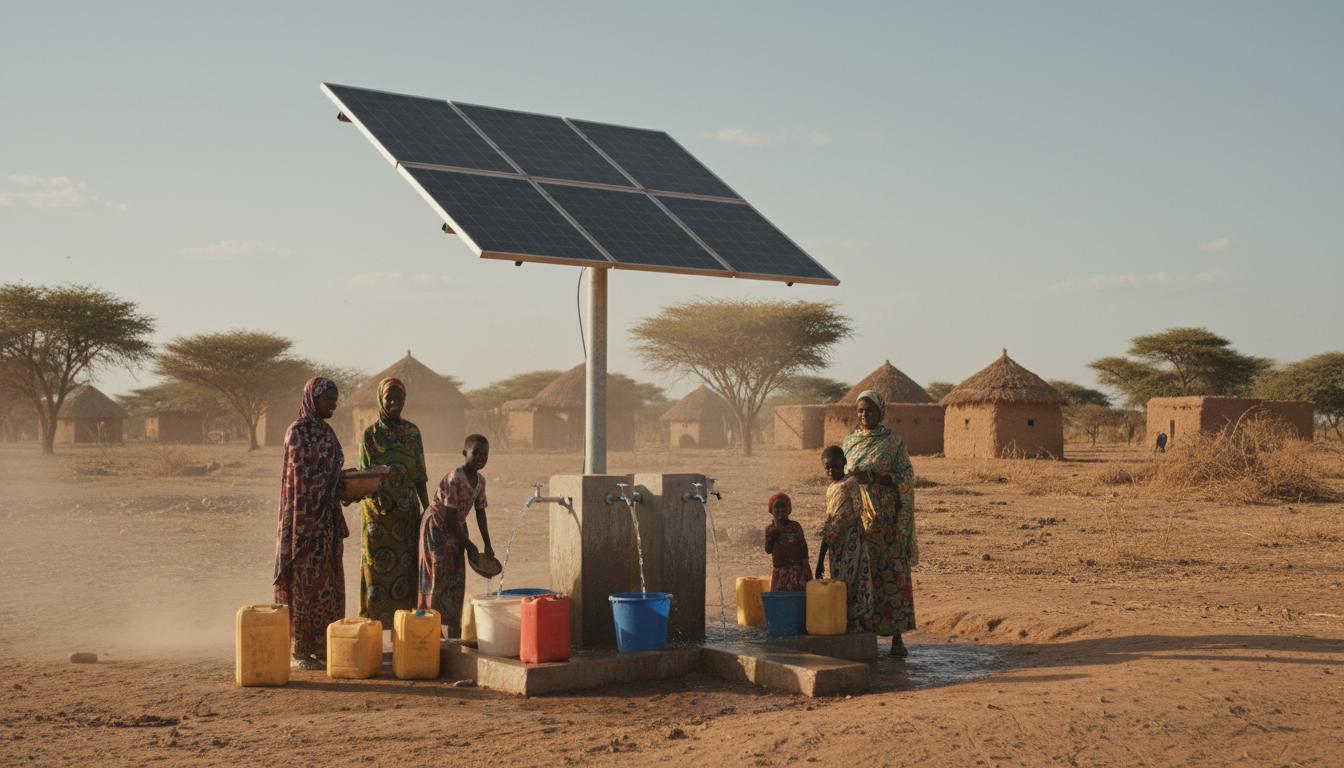
Sector: Renewable Energy, Food Security, WASH, Youth Employment, Market Systems
Executive Summary
Mercy of God Mission proposes the Namayingo Hub, a single‑site, solar‑powered infrastructure ecosystem that simultaneously addresses post‑harvest fish loss, water insecurity, youth unemployment, and exploitative market dynamics. By co‑locating an industrial solar cold storage unit, a high‑yield solar borehole, a mobile vocational training platform, and a cooperative market‑access programme, the Hub converts isolated interventions into a self‑reinforcing cycle of income generation, skills development, and community asset ownership. The model is designed for local maintainability, curricular integration, and financial hand‑over to community‑based structures within 36 months.
Problem Context & Urgency
- Post‑Harvest Fish Loss:
Up to 40% of the daily catch from Lake Victoria’s artisanal fisheries spoils before reaching a profitable market due to the absence of cold‑chain infrastructure. This translates into chronic income suppression, micronutrient deficits, and a disincentive to invest in sustainable fishing practices. - Water Insecurity:
Surface water sources are contaminated, and the carrying burden falls disproportionately on women and girls. A lack of reliable, high‑volume water supply constrains vocational training activities, small‑scale agriculture, and basic health outcomes in the immediate cluster of villages. - Skills Gap & Geographic Exclusion:
Formal technical and vocational education and training (TVET) centres are inaccessible to lakeshore youth due to distance, cost, and poor transport infrastructure. A generation of potential solar technicians, construction workers, and water mechanics remains unskilled and under‑employed. - Exploitative Market Structures:
Individual, unorganised fishers lack the bargaining power and storage capacity to negotiate fair prices. Middlemen capture a disproportionate share of the value chain, perpetuating a low‑equilibrium poverty trap.
These four challenges are interdependent and cannot be sustainably solved in isolation. The Namayingo Hub treats them as a single system.
Project Description: The Four‑Pillar Model
Pillar 1 — Industrial Solar Cold Storage
- Component: A walk‑in, solar‑photovoltaic‑powered cold room (‑5°C), sized to serve the landing site’s average daily production.
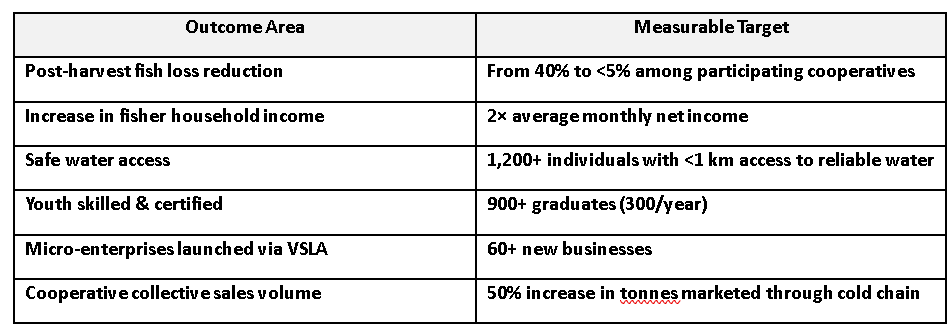
- Result: Post‑harvest loss reduced from ~40% to below 5%. Fish can be stored for up to 10 days, enabling cooperatives to aggregate volumes, time sales, and access premium urban and institutional markets.
- Technical Quality: System design and component selection are overseen by senior specialists in Appropriate Technology and sustainable resource management, ensuring that all parts are regionally serviceable and that the energy budget matches local solar irradiance without reliance on diesel backup.
Pillar 2 — Solar‑Powered Borehole & Water Supply
-
Component: A deep borehole equipped with a submersible DC pump and photovoltaic array, yielding ≥5,000 litres/hour. Storage tanks and distribution points serve the 4‑acre Hub site and adjacent villages.
- Result: Year‑round access to safe water for at least 1,200 beneficiaries. Elimination of water‑borne disease‑related workdays lost. Water availability enables hygiene, livestock, and demonstration‑plot irrigation on site.
- Curriculum Integration: The installation functions as a live practicum laboratory for the “Water Pump Repair & Maintenance” certification course, producing trained technicians who subsequently service district‑wide water points on a fee‑for‑service basis.
Pillar 3 — Mobile Vocational Training Unit
-
Component: A heavy‑duty vehicle retrofitted with fold‑out workstations, a solar‑powered tool‑charging system, audiovisual training aids, and secure equipment lockers. It delivers accredited short courses in Sustainable Construction (stabilised earth blocks, solar roof installation) and Solar PV maintenance.
- Result: ≥300 youth certified annually across multiple remote landing sites, without requiring students to relocate. Graduates receive a nationally‑aligned certificate and a starter tool kit, equipping them for immediate income‑generating activity in the green building and renewable energy sectors.
- Systemic Effect: The unit creates a geographically dispersed, employable workforce that can build and maintain climate‑smart infrastructure in their home communities, reversing rural‑to‑urban distress migration.
Pillar 4 — Fisheries Cooperative Support & Fair Market Access
- Component: Technical assistance to fishing cooperatives in collective marketing, cold‑chain logistics, and digital market‑price access. Integration with the Hub’s Village Savings and Loan Association (VSLA) model.
- Result: Cooperatives secure supply contracts with schools, hotels, and cross‑border traders at a 30–50% price premium compared to emergency distress sales. Fishers retain value‑added margins and build financial resilience.
- Financial Sustainability Link: VSLA members access Seed Capital grants (funded through programme revenues and donor contributions) to launch micro‑enterprises (solar fish smokers, cooling box rentals, transport services). Loan repayments recycle into the community fund, creating a perpetual capital pool independent of external grant support.
Implementation Approach & Sustainability
- Community Ownership from Day One: The Hub is governed by a locally elected committee representing fishers, women’s groups, youth trainees, and local government. Assets are legally held by the cooperative society, not an external entity.
- Technical Design for Maintainability: All hardware uses modular, off‑the‑shelf components available in the East African market. No proprietary “black‑box” technologies are deployed. Local technicians are trained on every system as part of the build.
- Revenue Model: The cold storage operates on a fee‑per‑crate basis; the borehole collects a minimal community contribution for a spare‑parts fund; the mobile unit generates income through small training fees and hired‑out construction services. Combined operating surpluses cover routine maintenance and a reserve fund within 18–24 months.
- Measurement & Learning: Key indicators (fish loss percentage, water flow rates, certification completions, cooperative revenue growth) are monitored quarterly and reported to donors with photographic evidence and beneficiary testimonials.
Anticipated Impact & Key Performance Indicators (3‑Year Horizon)
Funding Model & Investment Tiers
The Namayingo Hub is funded through a consortium of institutional grants, corporate social investment, and individual giving. All contributions map directly to durable assets with transparent per‑unit costs.
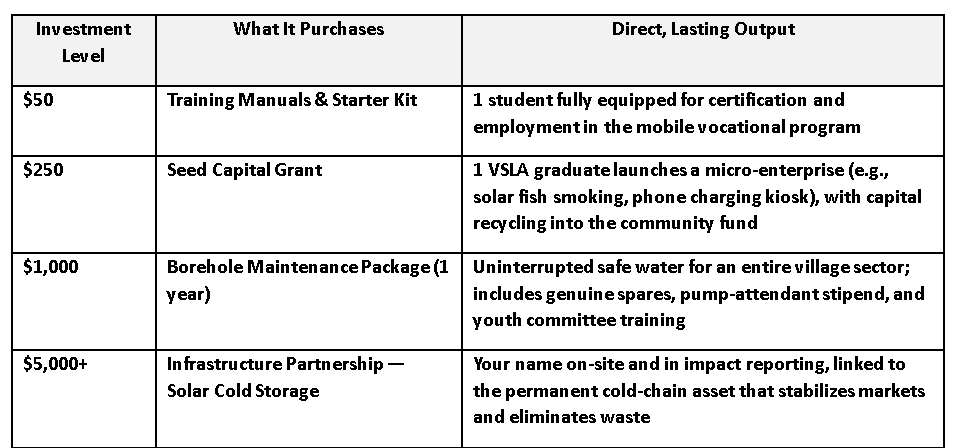
Larger institutional grants may underwrite a full pillar: a complete cold room installation, a borehole drilling and solar package, or the purchase and fit‑out of the mobile training unit.
Why Invest in the Namayingo Hub
- Systemic, Not Siloed: The model attacks the poverty cycle at multiple, linked pressure points — energy access, market failure, skills shortage, water security — creating a multiplier effect that single‑intervention projects cannot match.
- Permanent Capital: Donations are converted into physical infrastructure owned by the community, not into short‑term programme costs. The assets generate their own maintenance funding stream, ensuring functionality long after the grant period.
- Proven Technical Guidance: Every installation is reviewed by experts in Appropriate Technology, derisking the investment and aligning it with international best practices for off‑grid cold chains and solar water pumping.
- Transparent Reporting: Donors receive precise, metric‑based reports directly tying their contribution to tangible outcomes — a specific number of fish crates preserved, certificates issued, or litres of safe water delivered.
Call to Action
We invite foundations, corporate partners, and individual philanthropists to become Infrastructure Partners in the Namayingo Hub. By converting capital into solar‑powered, community‑owned hardware and skills, you are not merely funding a project — you are laying the physical and human infrastructure that will generate income, health, and resilience for thousands of families for decades to come.
To explore a tailored partnership or site visit, please contact: partners@mercyofgodmission.org or laeticia_anene@mercyofgodmission.org
Mercy of God Mission, Namayingo District, Uganda